Learning Partnerships
Some of the most valuable work happens before anyone knows what the solution is.
Increasingly, organisations invite me to work alongside them as a learning partner. Rather than delivering a predefined programme or producing a report at the end, I help teams make sense of complex challenges as they unfold.
This might involve interviews, workshops, observation, facilitation, qualitative analysis or collaborative sense-making. The methods vary, but the purpose is the same: helping organisations learn from their own experience and use that learning to shape practical action.
What is a learning partnership?
A learning partnership creates space to explore questions that do not yet have clear answers.
Together we:
listen across different perspectives;
identify patterns and underlying system dynamics;
test emerging ideas;
translate insight into practical action; and
adapt as learning develops.
Rather than separating research, facilitation and organisational development, a learning partnership brings them together.
How I work
My approach combines qualitative research, systems thinking and collaborative facilitation.
Sometimes I begin with interviews to understand different experiences across an organisation. Sometimes I facilitate workshops that enable participants to make sense of shared challenges together. Sometimes I synthesise learning across multiple activities to identify patterns that no single conversation would reveal.
The aim is not simply to produce evidence, but to help organisations build their own capacity to learn, adapt and improve.

Typical projects
Learning partnerships are particularly valuable where organisations are:
exploring an emerging challenge;
designing new services or approaches;
implementing organisational change;
evaluating complex programmes;
strengthening research culture;
developing researcher or professional staff capability;
building collaboration across organisational boundaries; or
wanting to understand not only what is happening, but why.
Current partnerships
Recent learning partnerships have included work with universities, sector organisations and research collaborations to explore topics including return to research after parental leave, emotionally demanding research, research culture, researcher development, leadership and organisational capability.
Each partnership is different, but they share a common principle: learning is not something that happens after the work. It is part of the work.
Current Partnerships
Learning partnerships work because they are independent. Without responsibility for a particular service, department or agenda, a learning partner can work across organisational boundaries, connect different perspectives and help organisations learn from themselves rather than defend existing positions.
White Rose University Consortium
Learning Partner – Supporting Return to Research
Learning partner for a cross-institutional initiative exploring how universities can strengthen support for researchers returning from extended parental leave.
Working alongside colleagues from the Universities of Leeds, Sheffield and York, my role combined qualitative research, collaborative sense-making and systems analysis to understand why return experiences varied despite similar institutional policies and resources.
Rather than evaluating individual services, the partnership focused on helping the consortium learn from researchers, managers and professional services colleagues across the whole research system. This involved interviews, cross-role case clinics, collaborative workshops and evidence synthesis to identify the organisational conditions shaping reintegration.
The project culminated in the development of a practical systems framework for institutional reintegration capability, supporting White Rose partners to move beyond isolated interventions towards more coordinated, evidence-informed approaches to implementation. The partnership has now evolved into an implementation phase, supporting ongoing organisational learning as recommendations are translated into practice across the consortium.

National Centre for Academic and Cultural Exchange (NCACE)
Learning Partner – Independent Research and the Changing Research Workforce
Learning partner supporting NCACE's exploration of independent research and the changing research workforce.
Working collaboratively with NCACE colleagues, my role combines qualitative inquiry, systems thinking and facilitated dialogue to help shape emerging thinking about independent researchers and their contribution to the UK's research and innovation ecosystem.
Rather than starting with predetermined solutions, the partnership is designed to learn from the experiences of independent researchers, sector leaders and organisations. Through collaborative workshops, evidence synthesis and strategic facilitation, the work explores how changing patterns of research careers can inform future policy, researcher development and cross-sector collaboration.
The partnership treats inquiry as part of the change process itself, using collective sense-making to develop practical, evidence-informed recommendations for the sector.
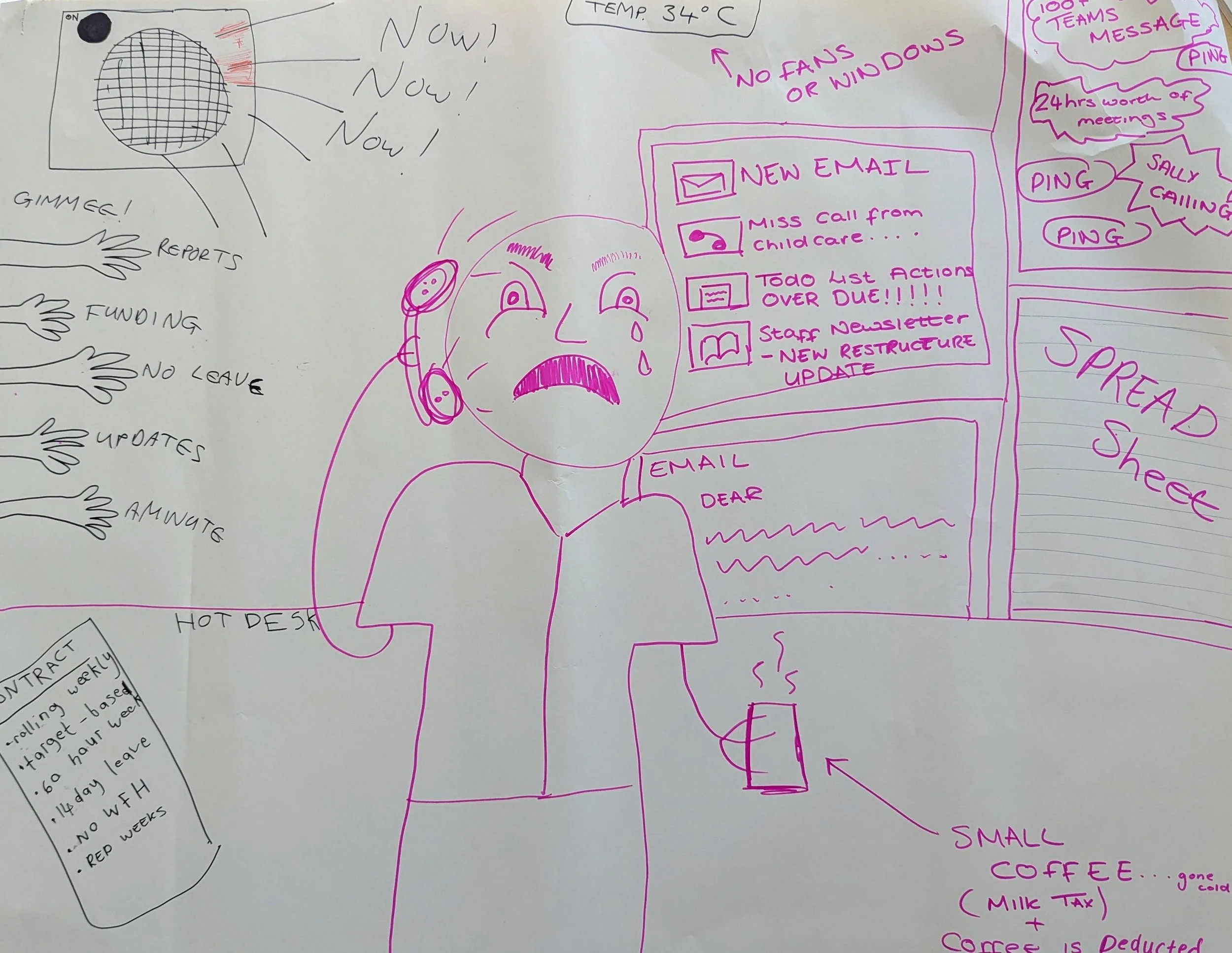
University of Kent
Learning Partner – Professional Services Capability
Learning partner supporting the development of a new professional services capability programme.
Rather than delivering a standard training package, the partnership combined facilitated workshops with qualitative synthesis to understand the experiences, challenges and strengths emerging across the cohort. Learning from participants was fed back into programme design, enabling the organisation to adapt and strengthen the programme as it developed.
The approach treated workshops as both developmental interventions and opportunities for organisational learning, helping translate individual experiences into wider insights about capability, collaboration and organisational change.